


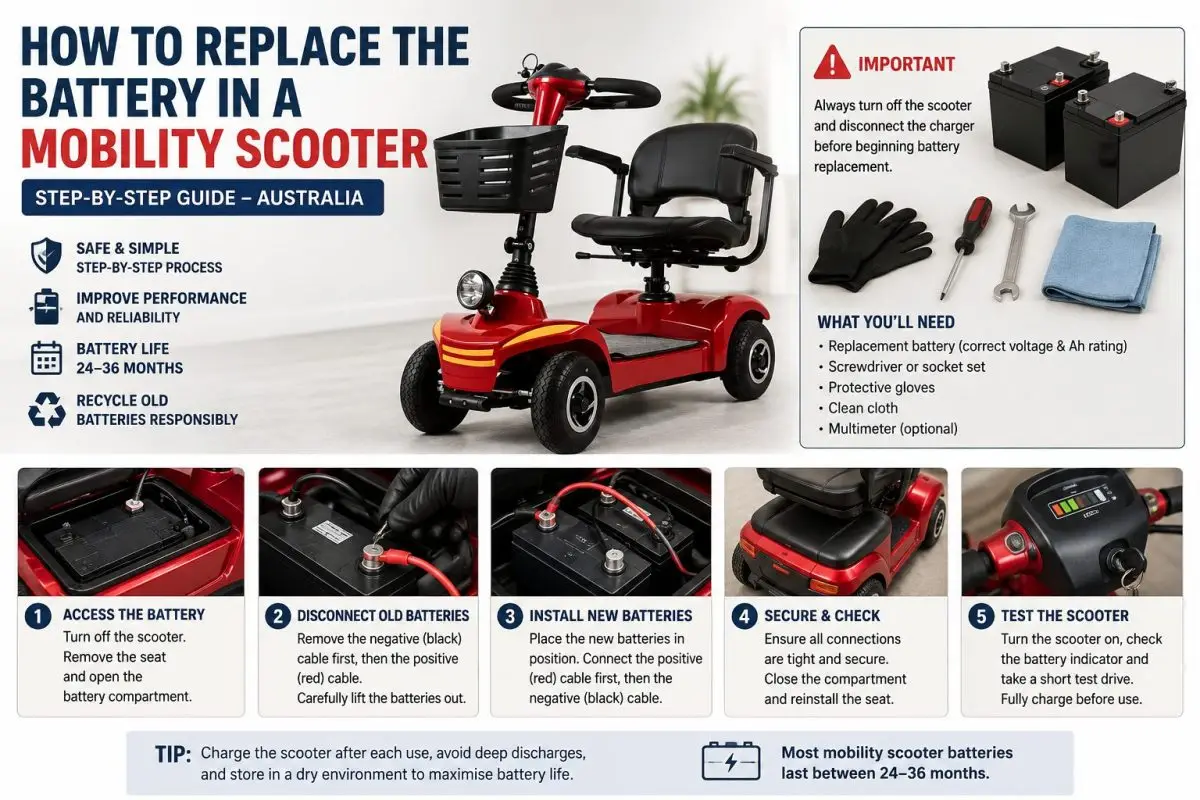
How to Replace the Battery in a Mobility Scooter (Step-by-Step Guide – Australia)
Replacing a mobility scooter battery is one of the most common maintenance tasks for mobility scooter owners. If your scooter is losing charge quickly, struggling on hills, showing reduced travel range, or failing to start reliably, the batteries may have reached the end of their service life.
This guide explains how to replace a mobility scooter battery safely and correctly while helping maximise battery performance and lifespan. Whether you use your scooter daily or occasionally, understanding mobility scooter battery replacement can help maintain reliability, independence, and community access. A well-maintained mobility scooter can play an important role in supporting day-to-day mobility and participation in the community.
Signs Your Mobility Scooter Battery Needs Replacing
Before replacing your mobility scooter battery, look for these common warning signs:
- Reduced travel distance per charge
- Slow acceleration or noticeable power loss
- Battery not holding charge overnight
- Longer charging times than normal
- Warning lights or battery faults appearing on the display
- Difficulty climbing slopes or ramps
- Reduced overall scooter performance
- Battery older than 24–36 months
Most mobility scooter batteries last between two and three years depending on usage, charging habits, terrain, storage conditions, and maintenance practices. Regular battery maintenance can help maximise battery life and reduce replacement frequency.
Before replacing batteries, it is also worth checking whether the charger, wiring, connectors, or battery terminals may be contributing to charging or performance issues. Battery issues are often responsible for reduced performance, but problems can also be caused by worn components, charging faults, or general wear and tear. If performance does not improve after replacing the batteries, it may be worth reviewing your mobility scooter or seeking professional servicing advice.
What You’ll Need
- Replacement battery with the correct voltage and amp-hour rating
- Screwdriver or socket set
- Protective gloves
- Clean cloth
- Multimeter, optional for voltage testing
- Manufacturer’s manual if available
Important: Always turn off the mobility scooter and disconnect the charger before beginning battery replacement.
How to Replace a Mobility Scooter Battery: Step-by-Step Instructions
Step 1: Identify the Correct Battery Type
Most mobility scooters use a 24V battery system consisting of two 12V batteries. Depending on the scooter model, these may be:
- Sealed Lead Acid (SLA) batteries
- AGM batteries
- Gel batteries
- Lithium batteries on selected newer models
Before ordering replacement mobility scooter batteries, check:
- Voltage rating
- Amp-hour (Ah) capacity
- Battery dimensions
- Terminal placement
- Manufacturer recommendations
Using the wrong battery type can affect charging performance, travel range, battery lifespan, and overall scooter reliability. If you are unsure which replacement battery is suitable for your scooter, compare the existing battery specifications or consult a supplier of replacement mobility scooter batteries before purchasing.
Step 2: Access the Battery Compartment
- Turn off the mobility scooter.
- Remove the seat if required.
- Open the battery compartment.
- Locate the battery pack and terminals.
Taking a photo of the wiring configuration before disconnecting cables can make battery installation much easier later.
Step 3: Disconnect the Old Batteries
- Disconnect the negative black cable first.
- Disconnect the positive red cable second.
- Remove retaining brackets or straps.
- Carefully lift the batteries out.
Mobility scooter batteries can be heavier than expected. Use safe lifting techniques and avoid damaging the battery casing.
Step 4: Install the New Batteries
- Place the new batteries securely into position.
- Connect the positive red cable first.
- Connect the negative black cable second.
- Ensure all terminals are clean and secure.
Loose battery terminals are a common cause of charging problems, intermittent power loss, and reduced performance.
Step 5: Test the Mobility Scooter
- Reinstall covers and seat.
- Turn the scooter on.
- Check battery indicator levels.
- Confirm there are no warning lights.
- Perform a short test drive in a safe area.
Fully charge the new batteries before extended use to ensure optimal performance.
Mobility Scooter Battery Replacement Tips
- Always replace batteries in pairs on a 24V system.
- Avoid mixing old and new batteries.
- Charge new batteries fully before first use.
- Use the correct mobility scooter battery charger.
- Keep battery terminals clean and dry.
- Store the scooter in a dry environment.
- Recycle old batteries through an authorised recycling facility.
Maintaining Mobility Scooter Battery Performance
For many mobility scooter users, battery reliability directly affects community access, participation in daily activities, appointments, shopping, and social engagement. Maintaining battery performance helps ensure the scooter remains a dependable mobility solution.
To maximise mobility scooter battery life and maintain reliable day-to-day mobility:
- Charge the scooter after each use.
- Avoid allowing batteries to completely discharge.
- Use the manufacturer’s recommended charger.
- Store the scooter away from extreme heat or cold.
- Arrange regular servicing if recommended.
Proper battery maintenance can significantly extend battery lifespan and help avoid unexpected breakdowns. Good charging practices may also improve mobility scooter range and overall performance.
Mobility Scooter Battery Replacement Cost in Australia
The cost of mobility scooter battery replacement depends on the battery type, capacity, brand, and scooter model. Standard sealed lead acid batteries generally cost less than lithium battery systems, while larger scooters often require higher-capacity batteries.
When comparing battery options, consider not only purchase price but also expected lifespan, warranty coverage, charging efficiency, and compatibility with your mobility scooter battery charger.
Investing in quality mobility scooter batteries can improve reliability, maximise travel range, and reduce long-term replacement costs.
When It May Be Time to Upgrade Your Mobility Scooter
Battery replacement will often restore performance; however, in some situations reduced reliability may be related to the age of the scooter, changing mobility requirements, or increased usage demands rather than the batteries themselves.
If a user’s transfer ability, travel requirements, seating needs, or support requirements have changed, it may be appropriate to review whether the current scooter remains suitable. Newer mobility scooters often offer improved comfort, suspension, battery efficiency, travel range, and safety features compared with older models.
Many modern scooters also provide larger battery capacities, improved reliability, and greater outdoor performance, making them suitable for users who require extended travel distances or more demanding daily use.
Frequently Asked Questions
How often should I replace my mobility scooter battery?
Most mobility scooter batteries require replacement every two to three years, depending on usage patterns, charging habits, and environmental conditions.
Can I replace a mobility scooter battery myself?
Yes. Many mobility scooter batteries can be replaced at home provided the correct safety procedures are followed and the replacement battery matches the manufacturer’s specifications.
Can I upgrade to lithium mobility scooter batteries?
Some mobility scooters can be upgraded to lithium batteries, but compatibility should always be confirmed before installation. The charger, controller, battery compartment, and manufacturer recommendations should all be checked before considering a lithium battery upgrade.
Why is my mobility scooter battery not charging?
Common causes include battery age, faulty chargers, damaged wiring, loose terminals, poor connections, or batteries that have reached the end of their service life. Mobility scooter battery troubleshooting should always begin with checking the charger, battery connections, and battery condition before replacing components.
Where can I buy replacement mobility scooter batteries in Australia?
Replacement mobility scooter batteries are available from specialist mobility equipment suppliers and should always be selected according to your scooter’s specifications.
Need Replacement Mobility Scooter Batteries?
If you are unsure how to replace a mobility scooter battery or need help selecting the correct battery for your scooter, our team can assist with battery compatibility, replacement advice, and product recommendations.
Browse our range of mobility scooter batteries, mobility scooters, and mobility equipment designed to support independence, comfort, and everyday mobility. Whether you’re replacing a battery or considering an upgrade, our team can help you find the right solution for your needs.
Shop Our Mobility Scooters
Folding travel scooters, 3-wheel, 4-wheel and heavy-duty models — designed for everyday independence across Australia. Lightweight and airline-safe options available. Try before you buy at our Sydney showroom.
From $1,990 · NDIS & Home Care Package funded · Free delivery on online orders · 1-year warranty
Browse Mobility Scooters → Get NDIS Quote Ask Our Team
Not sure which scooter suits you? Call (02) 8740 8963 · Test ride at our Showroom: 14 Smithfield Rd, Smithfield NSW



