


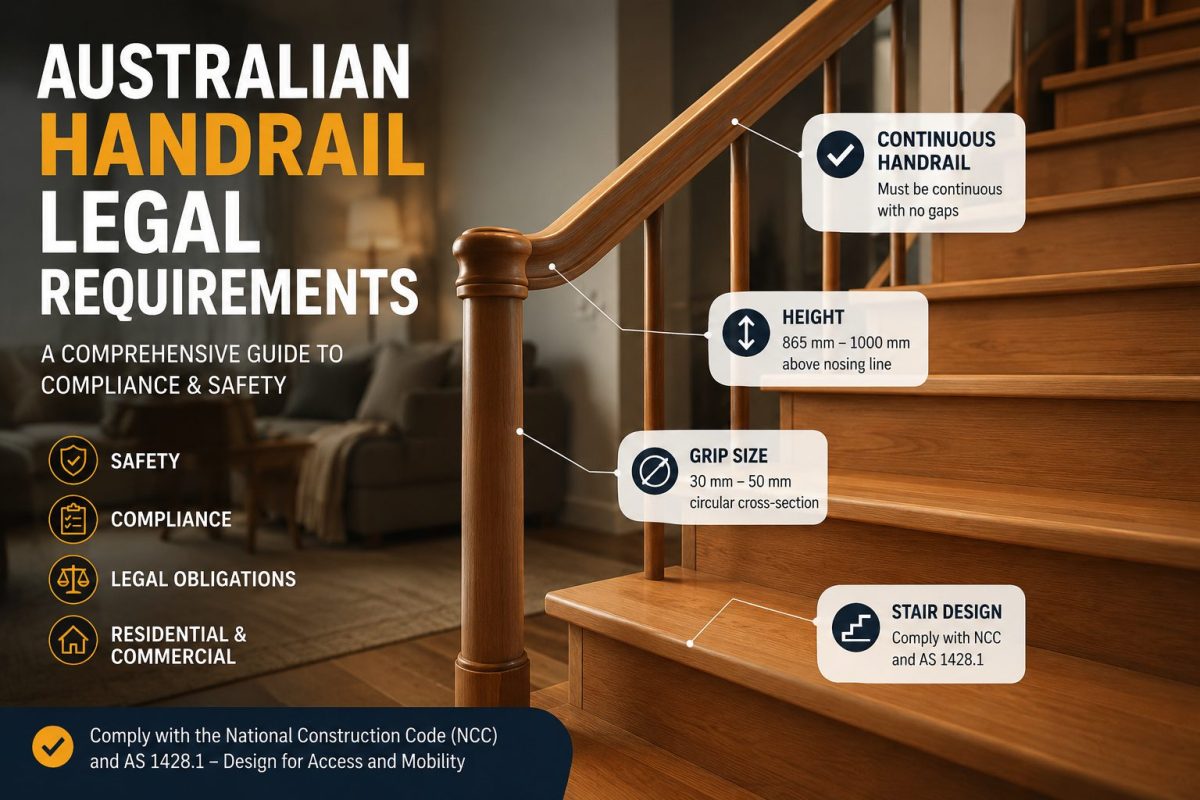
Australia has clear handrail legal requirements to ensure safety in residential, commercial and industrial buildings. This guide covers the key standards, dimensions, load requirements and compliance considerations — and explains when you need a handrail, what it must look like, and how to get one supplied or installed.
Need a handrail supplied or installed?
Handrails for outdoor steps, stairs & accessibility — Sydney & Australia-wide
Adjustable step handrails, customised stair rails and grab rails. NDIS funding available. Professional installation in Sydney and NSW.
Australian Standards for Handrails and Guardrails
The Australian Standard AS 1657-2018 (Fixed platforms, walkways, stairways and ladders) outlines key guardrail and handrail requirements for commercial and industrial settings. For residential buildings, the National Construction Code (NCC) and AS 1428.1 (Design for access and mobility) also apply — particularly for accessible design.
Key requirements under AS 1657-2018 include keeping the handrail for steps between 900mm and 1100mm above the floor surface or the nosing of a stair tread. Handrails must be smooth and continuously graspable, while guardrails include a top rail and knee rail to prevent falls.
Key Dimensions and Design Requirements
Handrail Height
Handrail height must be between 900mm and 1100mm above the floor or the nosing of the stair tread. For accessible design under AS 1428.1, the height range is 865mm to 1000mm. Where the risk of falling is significant, a guardrail used as a handrail may be set at 1000mm.
Cross-Section and Grip
Handrails must be circular with an external diameter of 30mm to 65mm. If square or rectangular, the sum of the height and width must be between 70mm and 100mm. A minimum clearance of 50mm from any adjacent wall or obstruction is required to allow a continuous, unobstructed grip along the full length.
Material and Load Requirements
Structural Strength
Guardrails and handrails must be rigid enough to withstand a 600N outward or downward force at any point without deflecting more than 100mm. This applies to both the rail and its fixing points to the structure.
Post Spacing
The maximum distance between handrail posts is 1,800mm. Posts must be fixed securely to maintain structural integrity under load and over time, particularly for outdoor installations exposed to weather.
Toeboard (Kick Plate)
Where required, a toeboard must extend at least 100mm above the floor surface and have a gap of no more than 10mm at the bottom to prevent small objects from falling and creating hazards below.
When Is a Handrail Required in Australia?
Under the National Construction Code, handrails are generally required:
- Residential stairs: required where there are more than 3 risers (steps)
- Ramps: required when the rise exceeds 190mm or the ramp length exceeds 1,900mm
- Both sides: required when the stairway width exceeds 1,000mm
- Commercial and public buildings: must also comply with accessibility requirements under AS 1428.1 and the Disability Discrimination Act (DDA)
For outdoor handrails for steps and stairs at residential properties, the same general height and structural requirements apply. See our guide on when a handrail is required in Australia for a full breakdown by building type.
Residential Handrail Requirements
Residential handrail legal requirements in Australia are governed by the NCC and, where accessibility is required, AS 1428.1. Key requirements for homes:
- All stairways with more than 3 risers must have at least one handrail
- Handrails must run the full length of the stair flight
- Where stair width exceeds 1,000mm, a handrail is required on both sides
- Height: 865mm to 1,000mm above the stair nosing for accessible design; 900mm to 1,100mm under AS 1657
- Must be continuous and graspable along the full length
Commercial Handrail Requirements
Commercial settings follow AS 1657-2018 requirements, which are more demanding than residential. Due to higher traffic and use, commercial handrails must withstand greater loads, meet DDA accessibility standards and be installed with appropriate guard accessories. Custom fabrication is often required to meet site-specific dimensions and loading requirements.
Compliance and Safety Enhancements
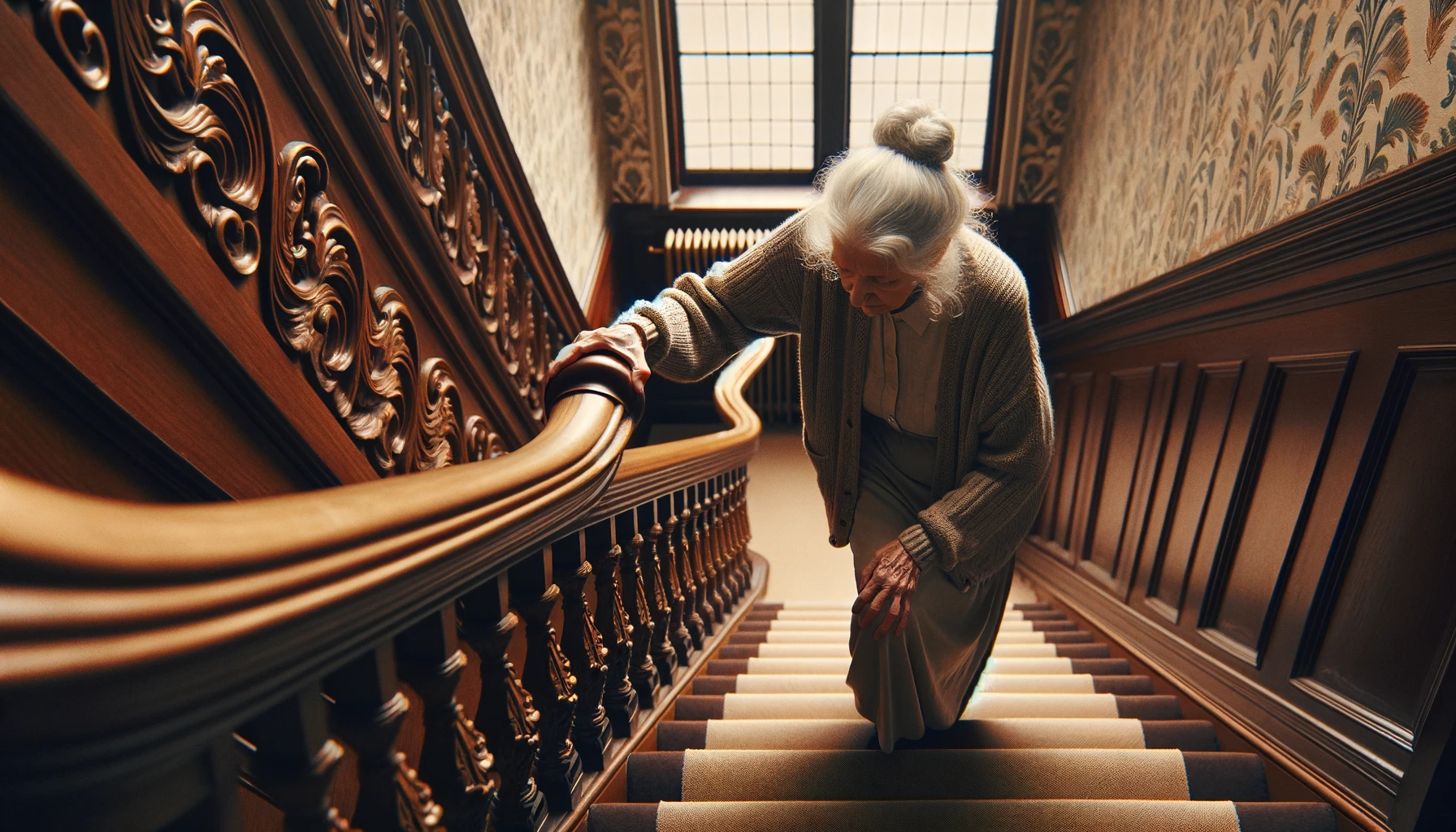
Beyond meeting minimum standards, well-designed handrails improve safety for all users — particularly elderly Australians and people with limited mobility. Additional considerations include:
- Non-slip grip surface — textured or rubberised coatings improve traction in wet conditions
- High-visibility markings — contrasting colours assist users with low vision
- Continuous graspability — no gaps, projections or interruptions along the full length
- Extensions at top and bottom — handrails should extend 300mm beyond the top and bottom of the stair for safe transitions
Installing a properly rated handrail for seniors and people with disability at home can significantly reduce fall risk and improve daily independence. NDIS home modification funding may be available for handrail installation at a participant’s primary residence.
Need a compliant handrail supplied or installed?
Adjustable outdoor step handrails, customised stair rails and accessibility grab rails. Professional installation in Sydney and NSW. NDIS funding available.
Outdoor Step Handrails → Customised Stair Rails Installation ServiceConclusion
Meeting Australian handrail legal requirements is not just a compliance issue — it directly affects the safety of everyone using your stairs, ramp or walkway. Whether for a home, aged care facility, commercial property or public space, correctly installed and maintained handrails reduce fall risk and improve accessibility for all users.
For guidance and supply, Gilani Engineering provides handrail installation in Sydney and NSW for residential, aged care and commercial properties. NDIS home modification funding may be available. The Australian Standard AS 1657-2018 is the primary reference document for commercial and industrial handrail design and construction.
Frequently Asked Questions
What are the Australian standards for handrails?
AS 1657-2018 covers fixed platforms, walkways, stairways and ladders in commercial and industrial settings. The National Construction Code (NCC) applies to residential and commercial buildings. AS 1428.1 sets additional requirements for accessible design for people with disability.
Does a house have to have a handrail?
Under the NCC, a handrail is required for residential stairs with more than 3 risers. Where the stair width exceeds 1,000mm, handrails are required on both sides. For people with mobility limitations, handrails on all stairs and ramps are strongly recommended regardless of the number of steps.
How many steps can you have without a handrail?
Under the NCC, a residential stairway with 3 or fewer risers does not require a handrail. Four or more risers generally require one. Requirements vary by state — always confirm with your local council or certifier.
What height should outdoor handrails be in Australia?
For outdoor stairs and steps, handrail height should be between 900mm and 1,100mm above the stair nosing under AS 1657. For accessible design under AS 1428.1 (ramps and accessible paths), the range is 865mm to 1,000mm. Both requirements may apply depending on the building type and use.
What is the AS 1657-2018 standard?
AS 1657-2018 is the Australian Standard for “Fixed platforms, walkways, stairways and ladders — design, construction and installation.” It specifies structural requirements, dimensions, load ratings and material standards for handrails and guardrails in commercial and industrial environments.
What is the standard clearance for handrails?
A minimum clearance of 50mm is required between the handrail and any adjacent wall or obstruction to allow a continuous unobstructed grip. Above the handrail, a clearance of at least 600mm is required.
What is the maximum distance between handrail posts?
The maximum spacing between handrail posts is 1,800mm under AS 1657-2018. For outdoor installations or heavier-use environments, closer spacing improves structural rigidity.
Can NDIS fund handrail installation?
Yes. Handrail installation at a participant’s primary residence may be funded as a home modification under NDIS where it is considered reasonable and necessary to support safe access. Gilani Engineering is a registered NDIS provider. Contact us for an NDIS quote.
Handrails — Supply & Installation Australia
Outdoor step handrails, customised stair rails, accessibility grab rails and commercial handrail systems. Designed to meet Australian standards. NDIS home modification funding available.
Free quotes · NDIS funding available · Sydney & NSW installation · Australia-wide supply
Outdoor Step Handrails → Customised Stair Rails Installation Service Get NDIS QuoteCall (02) 8740 8963 · Showroom: 14 Smithfield Rd, Smithfield NSW · Mon–Fri 7:30am–4:30pm · Sat 9am–2pm



