


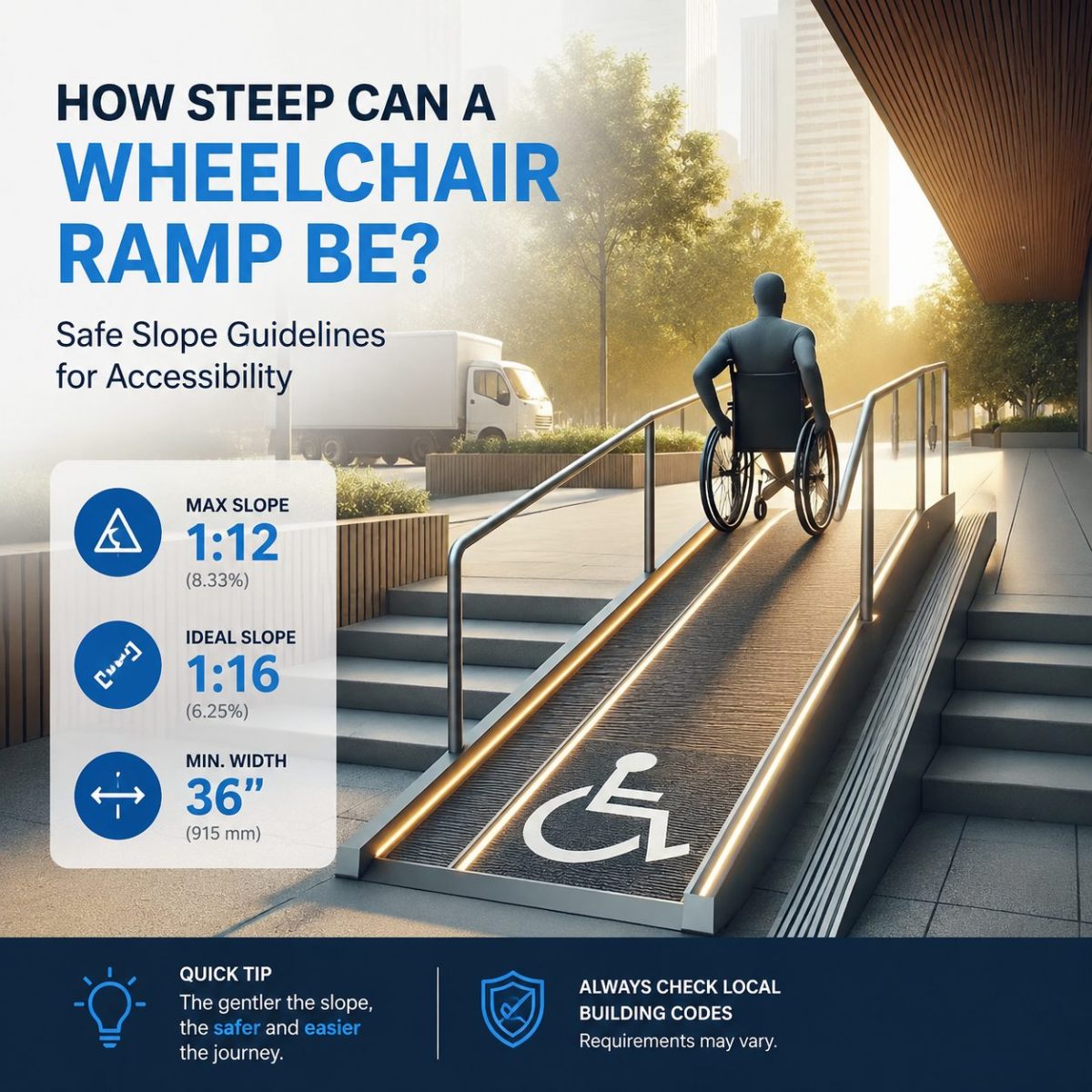
Designing wheelchair ramps requires careful attention to slope — too steep and the ramp becomes unsafe, too gentle and it takes up more space than is available. In Australia, ramp slope is regulated under AS 1428.1 with a maximum gradient of 1:14 for most accessible ramp applications.
This guide explains how to calculate ramp slope, what Australian standards require, and the practical factors that affect the right slope for your project. If you need a ready-made or professionally installed ramp, see our range of wheelchair ramps available across Australia.
What is the Slope of a Wheelchair Ramp?
Ramp slope describes how steep or shallow a ramp is. It is measured as a ratio, percentage or angle in degrees — each expressing the same relationship between vertical rise and horizontal run.
Slope Ratio
The slope ratio — such as 1:14 — expresses the relationship between vertical rise and horizontal run. A 1:14 slope means for every 1mm of vertical rise, the ramp extends 14mm horizontally. A gentler slope like 1:20 is easier to navigate but requires more space.
Slope Percentage
Slope percentage is calculated as: (Rise ÷ Run) × 100. A 1:14 gradient equals approximately 7.14%. A 1:20 gradient equals 5%. This measure is commonly used to verify compliance with accessibility standards.
Degrees
Degrees are less commonly used in accessibility standards but useful when comparing specifications. A 1:14 gradient equals approximately 4.1°. A 1:20 gradient equals approximately 2.9°.
How to Calculate Wheelchair Ramp Slope
The formula for ramp slope percentage is:
Slope (%) = (Rise ÷ Run) × 100
Example: A ramp rises 150mm over a horizontal run of 2,100mm:
Slope = (150 ÷ 2,100) × 100 = 7.14% — this is a 1:14 gradient, compliant with AS 1428.1
To find the minimum ramp length for a given rise, multiply the rise by 14: a 200mm rise requires at least 2,800mm of ramp at 1:14. See our full ramp gradient calculator guide for a complete reference table.
Need a ramp for your access point?
Wheelchair ramps from $90 — delivered Australia-wide
Threshold, portable folding and modular aluminium ramps. Tell us your rise and we’ll recommend the right length. NDIS funding available.
Why Slope Percentage Matters
Accessibility
Gentler slopes — lower percentages — are more usable by a wider range of users, including manual wheelchair users who must self-propel. Steep slopes require significantly more strength and effort.
Safety
Steep ramps increase the risk of tipping or losing control — particularly for manual wheelchair users. In wet conditions, a steep outdoor ramp becomes significantly more hazardous. A lower slope percentage produces a safer, more stable ramp.
Compliance
In Australia, AS 1428.1 specifies a maximum gradient of 1:14 (7.14%) for accessible ramps. Shorter ramps under 1,900mm can be up to 1:10. Gentler slopes like 1:20 are recommended where space allows, particularly for elderly users and powered mobility devices.
Australian Ramp Gradient Standard — AS 1428.1
The key wheelchair ramp gradient requirements under AS 1428.1 in Australia are:
- Maximum gradient: 1:14 (7.14%) for ramps over 1,900mm long
- Short ramps under 1,900mm: maximum 1:10 (10%)
- Preferred gradient: 1:20 (5%) where space allows — reduces fatigue for manual wheelchair users
- Minimum width: 1,000mm between handrails
- Landings: required at top and bottom, minimum 1,200mm × 1,200mm
- Non-slip surface: mandatory throughout
Ramp Slope Comparison Table
| Slope Ratio | Slope % | Degrees | Usability | Typical Use |
|---|---|---|---|---|
| 1:20 | 5% | 2.9° | Easy for most users | Preferred where space allows — AS 1428.1 |
| 1:14 | 7.14% | 4.1° | Moderate effort required | Maximum standard — AS 1428.1 Australia |
| 1:12 | 8.33% | 4.8° | Usable for most wheelchair users | ADA (USA) and BS 8300 (UK) public ramps |
| 1:10 | 10% | 5.7° | Challenging for manual wheelchair use | Short residential ramps under 1,900mm |
| 1:8 | 12.5% | 7.1° | Difficult, assistance likely needed | Limited-use, private settings only |
Regulatory Standards by Country
- Australia: AS 1428.1 — maximum 1:14 (7.14%) for accessible ramps; 1:20 preferred
- United States: ADA — maximum 1:12 (8.33%) for public access ramps
- United Kingdom: BS 8300 — maximum 1:12 for short ramps; 1:20 recommended for longer ramps
Factors Affecting the Right Ramp Slope
User type
Manual wheelchair users need gentler slopes than electric wheelchair users, who can manage steeper inclines with motor assist. Elderly users and people with limited upper body strength also benefit from 1:20 where possible.
Available space
A gentler slope requires more horizontal length — a 1:20 ramp for a 200mm rise needs 4,000mm versus 2,800mm for 1:14. Where space is tight, switchback designs with intermediate landings allow a gentler slope without a straight run.
Weather and surface conditions
Outdoor ramps exposed to rain need more moderate slopes and non-slip surfaces. A 1:14 outdoor ramp with no anti-slip treatment is significantly more hazardous in wet conditions than the same gradient with a textured surface.
Frequency of use
High-traffic public ramps should use the gentlest practical slope to accommodate the widest range of users. Private home ramps with limited use can use steeper gradients within the permitted range.
Best Practices for Ramp Design
- Follow AS 1428.1 — design to the Australian standard, not ADA (which is a US standard)
- Aim for 1:20 where space allows — safer and more comfortable for most users
- Include landings at top, bottom and any directional change — minimum 1,200mm × 1,200mm
- Install handrails when rise exceeds 190mm or ramp exceeds 1,900mm — both sides if ramp width exceeds 1,000mm
- Use non-slip surface — anti-slip grit tape or textured surface across full width every 150–200mm
- Provide minimum 1,000mm clear width between handrails
Frequently Asked Questions
What is the preferred slope for wheelchair ramps in Australia?
Under AS 1428.1, the maximum gradient is 1:14 (7.14%) for ramps over 1,900mm. A gentler slope of 1:20 (5%) is preferred where space allows — it is easier to navigate independently and reduces fatigue for manual wheelchair users.
Can a wheelchair ramp be steeper in a small space?
Shorter ramps under 1,900mm can be up to 1:10 (10%) under AS 1428.1. However, steeper slopes require more effort and are less safe, particularly for manual wheelchair users and in wet conditions. Switchback designs with landings can achieve a gentler slope where straight runs are not possible.
What is the minimum width of a wheelchair ramp in Australia?
AS 1428.1 requires a minimum clear width of 1,000mm between handrails. For high-traffic areas or ramps with directional changes, wider dimensions are recommended.
What is the maximum ramp length without a landing?
Under AS 1428.1, a landing is required at the top and bottom of every ramp, and at each directional change. For long ramps at 1:14 or less, a landing is required every 9 metres.
Why do outdoor ramps need gentler slopes?
Outdoor ramps are exposed to rain, which makes even moderate slopes hazardous without a non-slip surface. A gentler slope reduces the risk of accidents in wet conditions. Anti-slip grit tape or textured surfaces and adequate drainage are essential for any outdoor ramp.
Do all wheelchair ramps need handrails?
Under AS 1428.1, handrails are required when the ramp rise exceeds 190mm or the ramp length exceeds 1,900mm. Handrails must extend 300mm beyond the top and bottom of the ramp and be installed on both sides if the ramp width exceeds 1,000mm.
Can wheelchair ramps be portable?
Yes. Portable aluminium ramps are available for temporary or semi-permanent use — ideal for steps, vehicles and home access. Gilani Engineering stocks threshold ramps from $90, portable folding ramps and modular aluminium ramps available Australia-wide. NDIS funding may be available.
Conclusion
Wheelchair ramps designed with the correct slope, adequate width, proper landings and a non-slip surface create safe, accessible spaces that comply with Australian standards and serve all users effectively. In Australia, design to AS 1428.1 — maximum 1:14 gradient, with 1:20 preferred where space allows.
For ready-made aluminium ramps, professional ramp installation or NDIS-funded access solutions, Gilani Engineering supplies and installs across Australia. Explore our full range of wheelchair ramps or see our guide on how to calculate ramp gradient.
Wheelchair Ramps — Supply & Installation Australia
Threshold ramps, portable folding ramps, modular aluminium ramps and custom access solutions. Built to Australian standards. NDIS and Support at Home funding available.
From $90 · NDIS funding available · Free delivery Australia-wide · Professional installation Sydney & NSW
Browse All Ramps → Ramp Installation Service Get NDIS QuoteCall (02) 8740 8963 · Showroom: 14 Smithfield Rd, Smithfield NSW · Mon–Fri 7:30am–4:30pm · Sat 9am–2pm



