


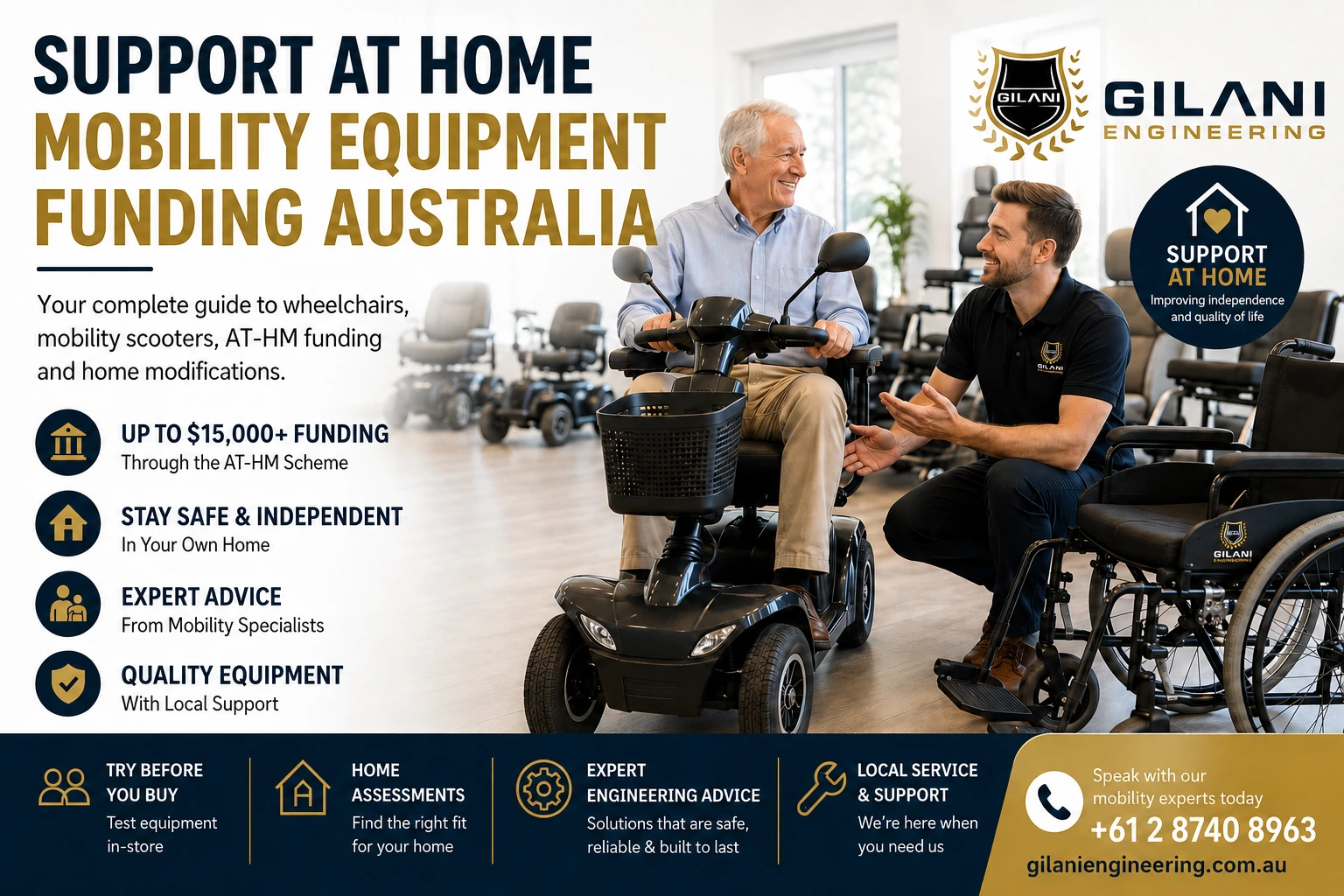
Everything Older Australians, Families, Occupational Therapists and Care Providers Need to Know in 2026
Quick Answer: Under the AT-HM Scheme (part of Support at Home, effective 1 November 2025), eligible older Australians receive separate funding — under $500 (Low), up to $2,000 (Medium), or up to $15,000 (High) per category, with combined Assistive Technology and Home Modifications funding of up to $30,000 — for wheelchairs, mobility scooters, shower chairs, ramps and home modifications. Funding is assessed via My Aged Care and outlined in your Notice of Decision. New participants may be income-tested for a contribution; transitioned HCP recipients generally are not.
Australia’s aged care system has undergone its biggest transformation in decades.
Under the new Support at Home Program, eligible older Australians can now access dedicated funding for mobility equipment and home modifications through the Assistive Technology and Home Modifications (AT-HM) Scheme. Unlike previous arrangements, participants no longer need to save funds from their regular care budget before accessing essential mobility equipment and safety modifications.
For many Australians, this means access to:
- Electric wheelchairs
- Manual wheelchairs
- Mobility scooters
- Walking frames
- Rollators
- Lift recliners
- Transfer equipment
- Pressure care products
- Access ramps
- Bathroom modifications
- Home accessibility upgrades
Yet despite the increased funding available, many families still make costly mistakes.
The biggest challenge is no longer obtaining funding.
The challenge is ensuring the equipment funded actually improves independence, safety and quality of life.
This guide explains everything you need to know about the Support at Home Program, AT-HM funding, eligibility requirements, mobility equipment selection, common mistakes and how to maximise your funding.
What Is The Support At Home Program?
Support at Home replaced the previous Home Care Package system on 1 November 2025, and was designed to simplify access to aged care services while helping older Australians remain independent in their own homes.
The program provides funding for:
- Personal care
- Domestic assistance
- Nursing services
- Allied health
- Social support
- Assistive technology
- Home modifications
One of the most significant changes is the introduction of dedicated funding streams for Assistive Technology and Home Modifications.
What Is The AT-HM Scheme?
The Assistive Technology and Home Modifications (AT-HM) Scheme provides separate funding for equipment and home modifications that help older Australians live safely and independently at home.
Importantly, this funding sits outside a participant’s regular Support at Home budget.
This means purchasing a wheelchair, mobility scooter or home modification no longer reduces the funds available for services such as cleaning, transport or personal care.
The scheme was specifically created to remove barriers to accessing essential equipment and modifications.
AT-HM Scheme vs NDIS Funding: What’s the Difference?
Many families are familiar with the NDIS but unsure how the AT-HM Scheme compares. Here’s a quick breakdown:
| Feature | AT-HM Scheme (Support at Home) | NDIS |
|---|---|---|
| Who it’s for | Older Australians (aged care) | People with disability under 65 at entry |
| Assessment | My Aged Care assessment | NDIS planning meeting |
| Funding structure | 3 tiers: $500 / $2,000 / $15,000 | Individualised plan budget |
| Approval document | Notice of Decision & Support Plan | NDIS Plan |
| Co-contribution | Income-tested for new participants | Generally none |
If you’re unsure which pathway applies to you or a family member, our team can help you understand your options, or read our NDIS Mobility Scooter Funding Guide if NDIS applies to your situation.
How Much Funding Is Available?
Funding is allocated according to assessed need.
Assistive Technology Funding Tiers
| Tier | Funding Amount |
|---|---|
| Low | Under $500 |
| Medium | Up to $2,000 |
| High | Up to $15,000 |
Home Modification Funding Tiers
| Tier | Funding Amount |
|---|---|
| Low | Under $500 |
| Medium | Up to $2,000 |
| High | Up to $15,000 |
Combined Assistive Technology and Home Modifications funding of up to $30,000 may be available depending on assessed need.
Note: for Assistive Technology, the $15,000 High tier is not a hard cap — where assessed needs genuinely require more, additional funding can be applied for with supporting evidence including a current prescription. For Home Modifications, $15,000 is a per-lifetime cap.
Your specific tier will be outlined in your Notice of Decision and Support Plan following your aged care assessment.
Equipment Packages by Funding Tier
The tier a participant receives is set by their aged care assessment, not by the equipment chosen. The packages below show examples of equipment from our range that typically suit each AT-HM tier, to help participants, families and OTs plan. Final selection and pricing depend on assessed needs and the specific models chosen — contact us for a quote.
Package 1 — Essential Safety & Daily Living
Tier 1 (Low) — under $500. Simple, low-cost items that generally do not require a prescription. Grab rails and ramps sit under the home modifications tier; daily living aids under assistive technology.
- Grab rails and handrails
- Threshold ramps and small portable ramps
- Basic shower chairs, commodes and bath boards
- Walking sticks and basic rollators
- Non-slip and bathroom safety aids
Package 2 — Mobility & Independence
Tier 2 (Medium) — up to $2,000. Items that benefit from professional advice to ensure they are selected, installed and used effectively — often supported by an OT recommendation and quote.
- Folding and portable ramps
- Premium rollators and walking frames
- Transfer aids and transfer boards
- Pressure care cushions and overlays
- Basic manual wheelchairs
- Bathroom safety equipment
Package 3 — Complex & Engineered Solutions
Tier 3 (High) — up to $15,000 (or more for assistive technology if assessed). Complex or higher-cost equipment requiring clinical assessment, and a prescription from a qualified health professional where required. This is where our in-house engineering and certification add the most value.
- Electric wheelchairs (folding and full-size)
- Mobility scooters (3-wheel, 4-wheel, heavy-duty)
- Electric hospital and adjustable beds
- Patient hoists and ceiling hoists
- Pressure care mattresses
- Stairlifts and portable stair climbers
- Home modifications — access ramps, bathroom redesign
- Vehicle modifications and NoRamp® wheelchair accessible vehicle conversions
We can supply by purchase or hire (supporting the scheme’s loan-before-buy principle), provide an invoice plus delivery or installation confirmation for AT-HM record keeping, and turn quotes around within 24 hours.
What Equipment Can Be Funded?
The AT-HM Scheme covers a broad range of products designed to improve safety, mobility and independence.
Mobility Equipment
Funding may cover:
- Walking sticks
- Walking frames
- Rollators
- Manual wheelchairs
- Powered wheelchairs
- Mobility scooters
- Transfer boards
- Hoists
Bathroom and Personal Care Equipment
Funding may cover:
- Shower chairs
- Commode chairs
- Bath boards
- Grab rails
- Toilet aids
Bedroom Equipment
Funding may cover:
- Adjustable beds
- Bed rails
- Pressure care mattresses
Safety Equipment
Funding may cover:
- Personal alarms
- Monitoring systems
- Fall prevention equipment
Home Modifications
Funding may cover:
- Access ramps
- Stair lifts
- Handrails
- Bathroom modifications
- Door widening
- Non-slip flooring
- Accessibility upgrades
Understanding the AT-HM List: Low Risk, Under Advice, and Prescribed Items
The Australian Government’s AT-HM List categorises every eligible product into one of three access levels:
- Low Risk — simple, low-cost items that don’t require a prescription or professional advice (e.g. basic walking sticks, bath boards)
- Under Advice — items that don’t need a prescription but benefit from allied health guidance to ensure correct fit and safe use (e.g. standard wheelchairs, shower chairs)
- Prescribed — higher-value or complex items requiring an Occupational Therapist or other prescriber’s assessment (e.g. powered wheelchairs, custom seating systems)
Most electric wheelchairs and mobility scooters fall under “Under Advice” or “Prescribed” — which is exactly where Gilani Engineering’s in-house engineering and allied health partnerships add the most value, helping ensure your prescribed equipment is approved correctly the first time.
The Biggest Misunderstanding About Mobility Equipment Funding
Most people assume:
“If funding is approved, any wheelchair or scooter will do.”
This is one of the most expensive mistakes families can make.
A mobility device is not simply a product.
It becomes part of someone’s daily life.
The wrong equipment can result in:
- Reduced independence
- Increased falls risk
- Pressure injuries
- Transport difficulties
- Poor posture
- Social isolation
- Expensive replacement costs
Government funding helps pay for equipment.
It does not guarantee the equipment is right for the person.
Why Mobility Equipment Should Never Be Chosen By Price Alone
A mobility scooter advertised online for $2,500 may seem like excellent value.
But important questions remain:
- Will it fit through the front door?
- Can it be transported safely?
- Is the seat appropriate?
- Can replacement batteries be sourced?
- Are spare parts available?
- Is local servicing available?
- Will it still meet needs in two years?
The cheapest quote is rarely the most important consideration.
Suitability is.
Why Occupational Therapists Matter
For many higher-value and more complex items, professional assessment is required before funding approval.
An occupational therapist may assess:
- Mobility requirements
- Transfer ability
- Posture
- Seating needs
- Home accessibility
- Falls risks
- Future requirements
This process helps ensure equipment recommendations are safe, appropriate and clinically justified. Gilani Engineering’s custom seating and modification team works closely with OTs to ensure every recommendation is clinically sound.
Are you an OT, case manager or home care provider? See how we work with providers — direct invoicing, 24-hour quotes and submission-ready documentation. Working with providers and healthcare professionals →
How Gilani Engineering Can Help With Your AT-HM Funding
Navigating the AT-HM scheme can feel overwhelming — between the AT-HM List, funding tiers, Notice of Decision paperwork, and finding equipment that’s actually right for you, many families don’t know where to start. Gilani Engineering helps Support at Home participants and their families at every step:
- AT-HM eligible products — our range of electric wheelchairs, manual wheelchairs, mobility scooters and bathroom safety equipment are suitable for AT-HM Low, Medium and High tier funding
- Quotes and documentation — we provide the invoices, quotes and product specifications needed to support your AT-HM funding tier request and Notice of Decision
- Working with your assessor or OT — we liaise with Aged Care Assessors and Occupational Therapists to ensure recommended equipment matches your assessed funding tier
- In-person trials — visit our Smithfield showroom to trial wheelchairs and mobility scooters before committing your AT-HM funding
- Long-term support — servicing, repairs and replacement parts available locally, so your AT-HM-funded equipment remains useful for years, not months
Note: AT-HM funding tiers provide under $500 (Low), up to $2,000 (Medium), or up to $15,000 (High) per category — with combined Assistive Technology and Home Modifications funding of up to $30,000 possible depending on assessed need. Always confirm your specific funding tier and eligible product list via My Aged Care.
Why Gilani Engineering Approaches Mobility Differently
Many suppliers start with a product catalogue.
Gilani Engineering starts with a person.
Before recommending equipment, we consider:
The User
- Physical capability
- Current mobility
- Medical conditions
- Future requirements
The Home
- Door widths
- Hallways
- Flooring
- Ramps
- Storage areas
- Charging requirements
The Environment
- Community access
- Shopping centres
- Transport requirements
- Vehicle compatibility
Long-Term Reliability
Our engineering background allows us to evaluate:
- Structural integrity
- Durability
- Serviceability
- Repairability
- Component quality
- Long-term ownership costs
Many suppliers focus on selling equipment.
We focus on ensuring that equipment continues delivering independence years after purchase.
The Seven Most Expensive Support At Home Mistakes
1. Buying Before Assessment
Assessment should always come before equipment selection.
2. Waiting Too Long After Funding Is Approved
AT-HM funding lapses after 12 months — unused funds do not roll over. Many families receive approval, then delay selecting equipment while they consider their options, only to find their funding period has expired. Once your Notice of Decision confirms AT-HM funding, move promptly. Gilani Engineering can help you trial, select and purchase the right equipment within your funding window.
3. Choosing Based On Price Alone
The cheapest equipment often becomes the most expensive mistake.
4. Ignoring Future Needs
Many mobility conditions are progressive.
5. Buying Equipment Without Trialling It
Whenever possible, equipment should be tested before purchase.
6. Ignoring Service Support
Who repairs the equipment matters.
7. Not Considering The Home Environment
Many products fail because they were never assessed within the actual home.
8. Choosing A Supplier Rather Than A Partner
Long-term support is often more valuable than a short-term discount.
How To Access Support At Home Funding
Step 1: Complete A My Aged Care Assessment
An assessment determines eligibility and identifies whether assistive technology or home modifications are required.
Step 2: Receive Your Support Plan
Approved funding will be outlined within your support plan and Notice of Decision.
Step 3: Obtain Professional Advice
More complex equipment may require occupational therapy assessment and prescription.
Step 4: Compare Providers
Don’t simply compare prices.
Compare:
- Assessment capability
- Industry experience
- Product range
- Service support
- Engineering knowledge
- Long-term assistance
Step 5: Implement And Review
Mobility needs can change.
Equipment should be reviewed periodically to ensure it continues meeting requirements.
Why Buying From a Physical Mobility Showroom Is Often the Better Choice
1. You Can Actually Try Before You Buy
Would you buy a car without driving it?
Yet many Australians spend thousands of dollars on mobility equipment they’ve never sat in.
A showroom allows you to:
- Compare multiple wheelchairs side by side
- Test mobility scooters indoors and outdoors
- Evaluate comfort and support
- Assess controls and usability
- Understand turning circles and manoeuvrability
Many people discover that the product they thought they wanted is completely different from the one that suits them best.
2. Mobility Equipment Is Not One-Size-Fits-All
Two people with the same medical condition can require completely different equipment.
Factors include:
- Height
- Weight
- Posture
- Strength
- Dexterity
- Balance
- Transfer ability
A physical provider can assess these factors in person. An online website cannot.
3. Your Home Environment Matters
One of the biggest reasons mobility equipment fails is because nobody checked whether it would work in the person’s home.
Questions that matter include:
- Will it fit through doorways?
- Can it navigate hallways?
- Is there sufficient turning space?
- Where will it be charged?
- How will it be transported?
A physical provider can often assess these factors before purchase. An online checkout page cannot.
4. You Get Expert Advice, Not Product Listings
Most websites provide specifications.
Good mobility providers provide recommendations.
There’s a significant difference.
A website may tell you:
- Width
- Weight
- Battery size
- Maximum speed
An experienced mobility consultant can explain:
- Which product suits your lifestyle
- Which model is easiest to transport
- Which seating system offers better support
- Which equipment is likely to remain suitable as needs change
5. Service and Repairs Matter
Mobility equipment is not a once-off purchase.
Eventually:
- Batteries wear out
- Tyres need replacement
- Motors require servicing
- Components fail
The question isn’t if repairs will be needed. It’s who will provide them.
When equipment is purchased through a local showroom-based provider, support is usually available when problems arise.
6. You Build a Long-Term Relationship
Many people require mobility equipment for years. Their needs may change over time.
A physical provider becomes a long-term partner who understands:
- Your condition
- Your home
- Your equipment history
- Future requirements
That’s difficult to achieve through an online-only transaction.
7. Engineering and Technical Knowledge Matter
At Gilani Engineering, we don’t just look at how equipment performs on the day it’s sold.
We evaluate:
- Structural durability
- Component quality
- Repairability
- Parts availability
- Long-term reliability
The cheapest equipment is not always the most economical. Equipment that lasts longer, can be serviced locally and remains suitable as needs change often provides far greater value over time.
When Online Purchasing May Be Appropriate
Online purchasing can work well for simple, low-risk products such as:
- Walking sticks
- Basic shower chairs
- Cushions
- Small accessories
However, for:
- Mobility scooters
- Electric wheelchairs
- Complex seating systems
- Lift recliners
- Adjustable beds
- Home accessibility equipment
the risks of purchasing without assessment, trial or support increase significantly.
The Bottom Line
A website can sell a product. A showroom can help determine whether it’s the right product. For mobility equipment, that’s an important distinction.
The goal isn’t simply to purchase a wheelchair or mobility scooter. The goal is to improve independence, safety, comfort and quality of life.
That’s why many Australians still choose a provider with a physical showroom, experienced staff, product demonstrations and ongoing support rather than relying solely on an online store.
Visit Our Showroom — Try Before You Buy
Book a visit to our Smithfield showroom to trial wheelchairs, mobility scooters and seating systems in person — with expert guidance every step of the way.
What Our Customers Say
“I purchased my Gilani Air Hawk… the wheelchair is a fine piece of engineering design and workmanship. The finish is superb in my opinion. Delivery was streamlined by Raj and Geoffrey from the Smithfield outlet. I certainly can recommend the products and the courtesy displayed.”
“The customer service at Gilani Engineering is second to none. The staff at the display rooms were helpful and knowledgeable. The gentleman that bought the unit to our home for a trial was phenomenal. All information given, all questions answered. Having dealt with another company before, Gilani is in a field of its own.”
Frequently Asked Questions
Can Support At Home Pay For A Mobility Scooter?
Yes. Mobility scooters are included within the AT-HM Scheme where clinically appropriate and approved through assessment.
Can Support At Home Pay For An Electric Wheelchair?
Yes. Powered wheelchairs may be funded where prescribed and clinically justified.
Do I Need An Occupational Therapist?
For more complex equipment, an occupational therapist or other qualified health professional may be required.
Can Funding Cover Home Modifications?
Yes. The scheme specifically funds accessibility modifications including ramps, rails, bathroom modifications and other approved improvements.
Can I Choose My Own Supplier?
Participants generally work with their Support at Home provider and approved suppliers to source equipment appropriate to their needs.
What’s the difference between the AT-HM Scheme and the old Home Care Package equipment funding?
Under the old Home Care Package system, equipment had to be funded from your regular care budget — reducing funds available for other services. Since 1 November 2025, the AT-HM Scheme provides separate, dedicated funding for assistive technology and home modifications, so it no longer competes with your everyday care budget.
Will I have to pay anything towards my AT-HM funded wheelchair or mobility scooter?
If you transitioned from a Home Care Package, generally no additional contribution is required. New Support at Home participants may be asked for an income-tested contribution, assessed by Services Australia. Contact our team if you’re unsure how this applies to you.
Note: the automatic data collection pathway that allowed transitioned HCP recipients to access AT-HM funding without a Support Plan Review closed on 13 February 2026. If you transitioned from a Home Care Package but have not yet accessed your AT-HM funding, contact your Support at Home provider to discuss the current process.
Can I use AT-HM funding to buy a wheelchair from Gilani Engineering?
Yes. Gilani Engineering supplies a wide range of AT-HM eligible wheelchairs, mobility scooters and home safety equipment, and can provide the quotes and documentation needed to support your funding tier request.
How long does AT-HM funding last?
In most cases, AT-HM funding is available for 12 months from when your service agreement is signed. Unused funds do not roll over — any unspent allocation lapses at the end of the funding period. Two exceptions apply:
– Progressive conditions (such as motor neurone disease or Parkinson’s disease) — automatically receive 24 months for assistive technology funding, with a possible extension to 48 months
– Complex high-tier home modifications that cannot be completed within 12 months — can be extended to 24 months with supporting evidence
If your funding period is approaching and equipment has not yet been purchased, contact your Support at Home provider promptly. Gilani Engineering can provide quotes and documentation quickly to support timely approval.
Final Thoughts
The Support at Home Program and AT-HM Scheme represent one of the most significant investments in independence and quality of life for older Australians.
But the best outcomes don’t come from funding alone.
They come from choosing the right equipment, receiving the right advice and working with people who understand both mobility and long-term independence.
Before accepting the cheapest quote online, ask yourself:
- Will this equipment still be right for me in three years?
- Can it be serviced locally?
- Has anyone assessed my home?
- Has anyone assessed my future needs?
The answers to those questions often determine whether mobility equipment becomes life-changing — or simply another unused item sitting in the garage.
Speak With Gilani Engineering
Whether you’re exploring a mobility scooter, powered wheelchair, lift recliner, ramp or other assistive technology solution, Gilani Engineering helps Australians make informed decisions that prioritise independence, safety and long-term value.
Because the right equipment isn’t just about mobility.
It’s about maintaining freedom, dignity and confidence for years to come.
Get Expert Advice on Support at Home Funding
Speak with our team about AT-HM funding, equipment assessments, and finding the right mobility solution for your home and lifestyle.
Reviewed by Ramin (Ray) Gilani — Mechanical Engineer, Founder of Gilani Engineering
18+ years engineering and supplying mobility equipment to NDIS and aged care participants across Australia. This guide is reviewed periodically to reflect current Support at Home and AT-HM scheme information.
Gilani Engineering is an ISO 9001 quality-certified, NDIS registered provider, with in-house VSCCS vehicle safety certification (Transport for NSW Licence #170005).
Last reviewed: June 2026 · Always confirm current funding tiers and eligibility via My Aged Care.



