


GILANI ENGINEERING · G24 NORAMP®
Your next journey starts with easier access
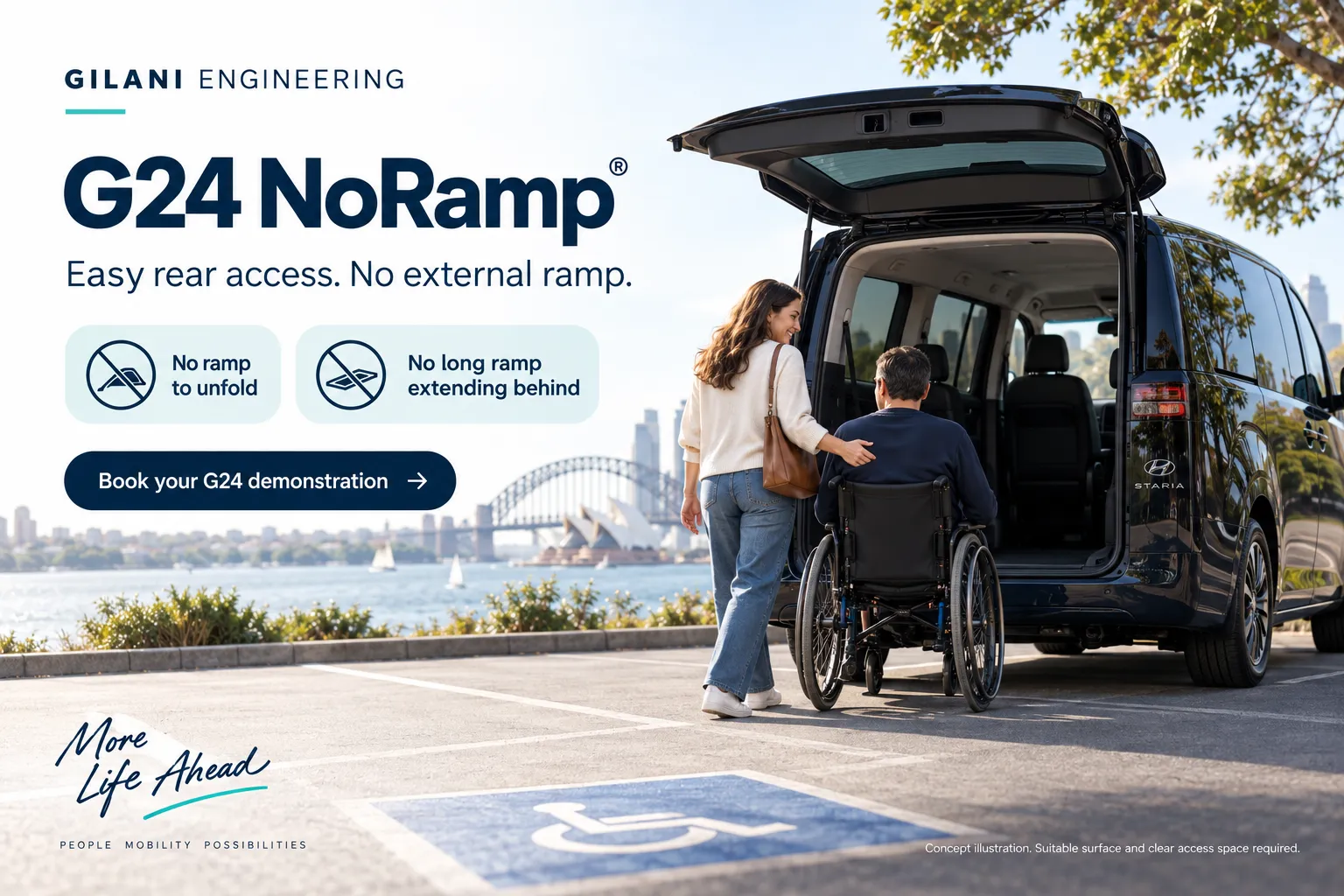
Discover a wheelchair vehicle conversion with no external ramp to unfold. Explore G24 NoRamp for the Kia Carnival and Hyundai Staria, then experience the entry system and seating layout with your own wheelchair.
Book your G24 demonstrationA wheelchair-accessible vehicle should work around your everyday journeys: getting to appointments, visiting family, heading to work or enjoying a day out. With a G24 NoRamp wheelchair conversion, you can explore a rear-entry system that removes the need to deploy a long external ramp.
The best way to understand the difference is to see it working. Bring your wheelchair, invite the person who usually travels with you and compare the access process and seating options with Gilani Engineering.
Why choose G24 NoRamp?
No external ramp to unfold
With a conventional ramp-based conversion, the boarding routine includes deploying a ramp before entry and stowing it afterwards. G24 NoRamp uses a powered lowering-floor system instead. You can see the complete process on our NoRamp wheelchair vehicle conversion page and ask to try it during your demonstration.
No long ramp extending behind the vehicle
A deployed external ramp takes up space beyond the vehicle. G24 removes that part of the access footprint. You still need a clear approach for the wheelchair, room for the open tailgate and working space for anyone assisting, but there is no long ramp to accommodate behind the bumper.
Bring photos or measurements of the places you park most often. A demonstration can then focus on your driveway, garage, workplace or regular destinations.
A seating layout to discuss around your needs
Access is only the start of the journey. Where would you like to sit? Who needs to be nearby? What else needs to travel with you? Discuss these questions alongside the wheelchair entry system so your proposed conversion covers the whole trip.
Explore the G24 wheelchair seating positions guide before your visit. It explains the seating concepts you can discuss with the team.
A demonstration using your own wheelchair
A brochure cannot show how your headrest, footplates, joystick, cushion and everyday accessories work together inside a particular conversion. Bring the chair you actually use. Take time to experience the travelling position and ask your usual companion to try the tasks they would normally complete.
G24 NoRamp vs a ramp or platform lift
The G24 difference: rear access without a long external ramp to unfold or accommodate behind the vehicle. Compare the complete boarding process, then try G24 with your own wheelchair.
Scroll sideways to compare all three options.
| Feature | G24 NoRamp® | Conventional ramp conversion | Occupied wheelchair platform lift |
|---|---|---|---|
| How the wheelchair enters | Powered lowering floor provides rear entry. | Wheelchair travels along an inclined ramp. | A powered platform raises the occupied wheelchair. |
| External ramp to unfold | No long external ramp to unfold. | Ramp must be deployed and stowed; operation varies by system. | No boarding ramp required, but a lift platform deploys. |
| Space outside the vehicle | No long ramp deployment area. Clear space is still required for the tailgate, wheelchair and assistance. | Allow for the deployed ramp plus the wheelchair approach and assistance. | Allow for the deployed platform, wheelchair approach and operator position. |
| Tasks to try | Controls, entry, positioning and the complete travel setup. | Ramp handling, moving along the incline and stowing the ramp. | Platform deployment, wheelchair positioning, controls and stowage. |
| Ground and parking conditions | Check the actual surface and system operating limits. | Check surface conditions, ramp support and the resulting incline. | Check surface conditions, deployment area and manufacturer’s operating limits. |
| Using it independently | Assess the complete process, including restraints. | Assess the complete process, including ramp handling and restraints. | Assess the complete process, including controls and restraints. |
| Seating and wheelchair fit | Confirm the G24 layout for your wheelchair and passengers. | Confirm the converted cabin and approved wheelchair position. | Confirm the cabin, platform and stowed lift space. |
| Comparing price | Request the full conversion scope and optional equipment. | Request the full conversion scope, not just the ramp price. | Request installation and vehicle work, not just the lift price. |
Exact requirements vary by system and vehicle. No option should be assumed suitable for every surface, every wheelchair or every parking location.
See the G24 difference — book a demonstrationHow does G24 NoRamp work?
The G24 access system lowers the entry floor, allows the wheelchair user to enter and returns the system to its travelling position. Your demonstration covers the operating sequence for the specific vehicle and fitted equipment.
- Prepare the rear access area. Check the approach and open the vehicle as demonstrated.
- Operate the lowering system. See how the controls bring the access floor down.
- Enter and position the wheelchair. Try the route with the chair and accessories used for everyday travel.
- Complete the travel setup. Follow the demonstrated restraint and raising sequence, including the checks required before travel.
Your handover includes the operating sequence, system limits, maintenance and backup procedure.
G24 Kia Carnival or Hyundai Staria?
Both vehicles are starting points for a G24 discussion. Choose by comparing the actual conversion, rather than assuming that the original vehicle’s seat count or boot dimensions will carry through to the finished layout.
| Your question | Kia Carnival G24 | Hyundai Staria G24 |
|---|---|---|
| Where can I see the conversion? | Explore the Kia Carnival G24 | Explore the Hyundai Staria G24 |
| How do I enter? | G24 NoRamp rear access, subject to the selected build. | G24 NoRamp rear access, subject to the selected build. |
| Where will the wheelchair travel? | Discuss the available second-row, third-row and other proposed layouts. | Discuss the available second-row, third-row and other proposed layouts. |
| Will my wheelchair fit? | Trial entry, occupied headroom, footplate space and restraints. | Trial entry, occupied headroom, footplate space and restraints. |
| How many people can travel? | Confirm the seats usable with the wheelchair position occupied. | Confirm the seats usable with the wheelchair position occupied. |
| Can I convert my existing vehicle? | Provide its year, variant, drivetrain and current modifications. | Provide its year, variant, drivetrain and current modifications. |
| What should my quote show? | Vehicle or conversion-only scope, layout and optional equipment. | Vehicle or conversion-only scope, layout and optional equipment. |
Tell the team whether you already own a vehicle or are still choosing one. Confirm compatibility before purchasing a Carnival or Staria for conversion.
Choose where you want to travel
Think about the journeys you make most often. A weekday trip with a companion may need a different passenger arrangement from a family outing with bags and equipment. Bring both examples to the discussion.
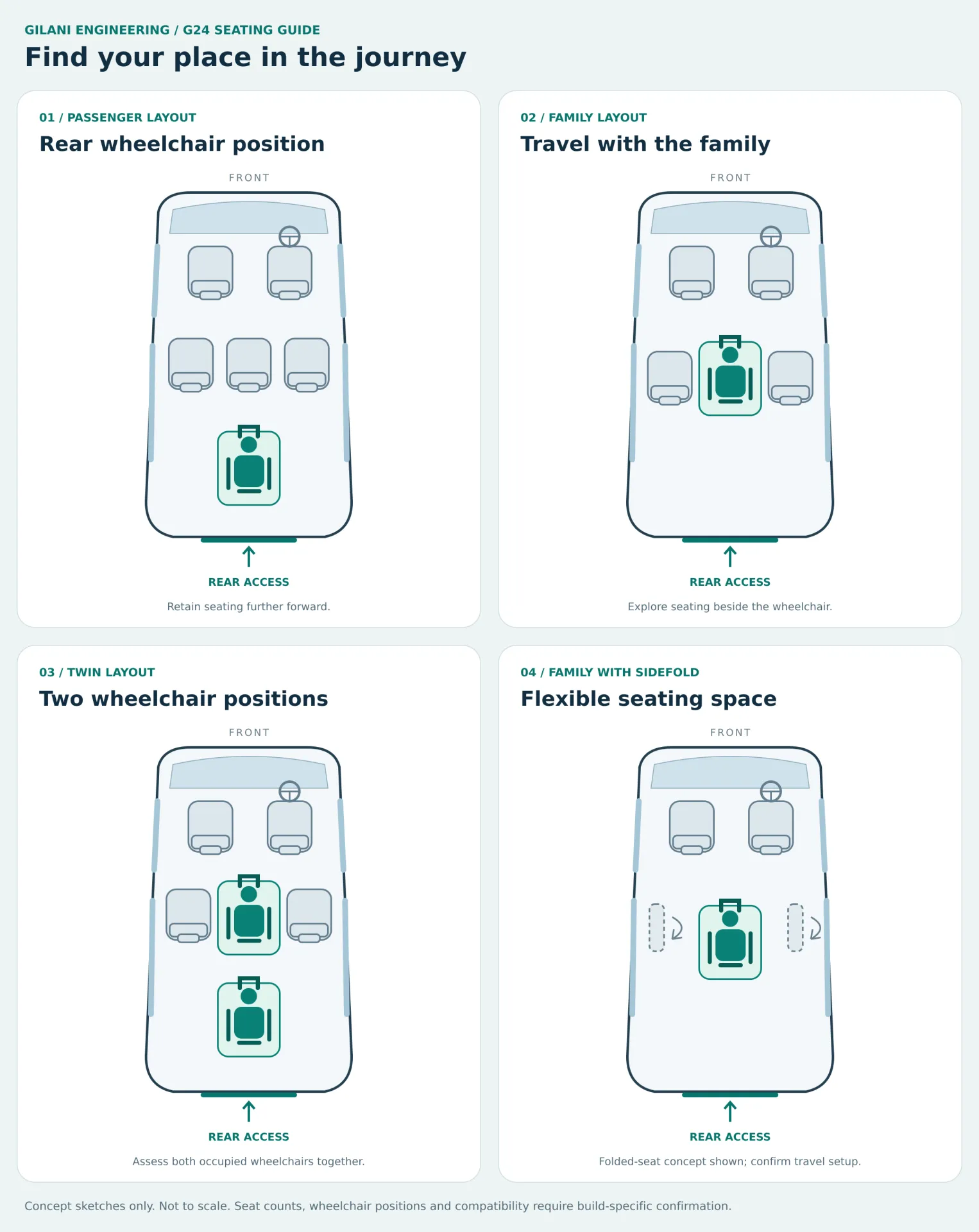
- Passenger: explore a wheelchair position towards the rear with passenger seating further forward.
- Family: discuss a wheelchair position further forward and the seats available for companions.
- Twin: ask about a proposed arrangement for two wheelchair users and assess both chairs together.
- Family with Sidefold: discuss folding-seat options and see which seats can be occupied in each arrangement.
Our seating guide includes sketches and a detailed comparison. Use it to shortlist the layouts you would like to discuss.
What about parking space and different surfaces?
G24’s space advantage comes from removing the external ramp deployment area. The useful question is how the complete setup works where you actually park: the position of the vehicle, the rear opening, the wheelchair approach and any assistance.
Send photos showing the area behind the vehicle as well as the ground surface. Include changes in level, driveway slopes, kerbs and nearby obstacles. Ask the team to explain which conditions are suitable for the specific system.
Do not assume that any wheelchair vehicle conversion can be operated on every surface. G24 suitability should be checked against the supplied system’s operating limits. A practical assessment is more useful than a general promise about uneven ground or tight parking.
Questions to bring
- Can I enter and leave in my usual parking location?
- Where would my companion or support worker stand?
- How should I position the vehicle on this driveway?
- What changes if the surface is wet, sloping or uneven?
- What alternative parking position should I use if access is obstructed?
See G24 working with your own wheelchair
The purpose of your demonstration is to understand the access process and discuss a suitable conversion. It also gives you time to ask questions that are difficult to answer from photographs alone.
Before your visit
Send your wheelchair make and model, preferred vehicle and the number of people who normally travel. Mention any accessories, support equipment or transfer requirements that affect your setup. If you have an occupational therapist’s recommendations, share those too.
Bring the things you use every day
- Your wheelchair with its usual cushion, headrest and accessories.
- Your regular companion, carer or support worker where possible.
- Information about bags or equipment you need to carry.
- Photos or measurements of your driveway and usual parking locations.
- Details of an existing vehicle you would like assessed.
During the demonstration
Ask to see the complete boarding and exit sequence. Check your view from the proposed travelling position, communication with companions and the room around your feet and head. Allow time for the person assisting to practise the relevant tasks.
Get a quote for the G24 setup you need
Your quote should identify the vehicle, conversion layout, passenger seating and equipment being supplied. Tell the team whether you need a complete vehicle or a conversion of your own vehicle so the scope is clear from the start.
Ask about any optional equipment, delivery arrangements, documentation, handover and servicing requirements. Confirm the proposed schedule and request the written warranty terms for the system and conversion work.
For help preparing your enquiry, read our wheelchair vehicle conversion cost guide. If you are still deciding how you will travel, start with the vehicle planning guide.
G24 NoRamp: frequently asked questions
What is a G24 NoRamp wheelchair conversion?
It is a wheelchair-accessible vehicle conversion with a powered lowering-floor system for rear entry. It removes the need to deploy a long external ramp. Explore the NoRamp system overview or arrange a demonstration.
Does G24 need an external ramp?
The NoRamp access system does not use a long external ramp that must be unfolded behind the vehicle. Ask to see the entry process in the specific conversion you are considering.
Does G24 need a large parking space?
There is no long ramp deployment area to accommodate, but you still need suitable space for the vehicle, open tailgate, wheelchair approach and anyone assisting. Bring details of your normal parking locations so the team can discuss the full access area.
Can G24 be used on uneven surfaces?
That depends on the surface and the operating limits of the fitted system. Do not assume that every slope or uneven area is suitable. Share photographs or measurements and ask how the vehicle should be positioned and operated.
Can I try G24 with my own wheelchair?
Contact Gilani Engineering to arrange a demonstration and confirm the available vehicle. Provide your wheelchair details in advance and bring the usual accessories so the discussion reflects your everyday setup.
Is G24 available for the Kia Carnival and Hyundai Staria?
Gilani offers G24 conversions for selected Kia Carnival and Hyundai Staria vehicles. Confirm suitability for the exact year, variant, drivetrain and proposed layout before purchasing a vehicle or booking work.
Can I remain seated in my wheelchair?
Discuss an occupied wheelchair travelling position as part of your conversion assessment. The wheelchair, passenger, restraints and vehicle arrangement need to be considered together. Boarding access alone does not confirm an approved travel setup.
Can an electric wheelchair be used?
Provide the exact model, dimensions, weight and accessories. Suitability depends on the occupied chair’s fit, the access route, restraint arrangement and applicable operating load. A powered wheelchair label alone does not establish compatibility.
Can I choose a second-row or third-row wheelchair position?
Discuss the available positions for your proposed vehicle and conversion. Our wheelchair seating positions guide explains the layout concepts. A finished vehicle’s approved positions should not be assumed interchangeable.
Can two wheelchair users travel together?
Ask about a Twin configuration for the proposed vehicle. Both wheelchairs should be assessed together, including accessories, restraint access, boarding order and the seats available while both wheelchair positions are occupied.
Can I use G24 without assistance?
This needs an individual assessment. Consider opening the vehicle, using the controls, positioning the wheelchair and completing the travel setup. Powered access does not by itself establish that every task can be completed independently.
How much does a G24 conversion cost?
Request a quote for your vehicle and layout. Confirm whether it includes the vehicle itself, conversion work, restraints, optional equipment and delivery. The conversion cost guide can help you prepare the details.
How do I book a demonstration?
Use the Gilani Engineering contact page and ask for a G24 NoRamp demonstration. Include your wheelchair model, preferred vehicle, who normally travels with you and any relevant assistance requirements. The team can confirm an appointment and available vehicle.



